


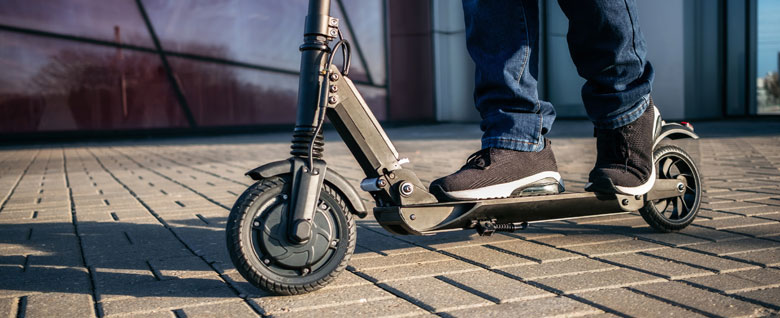
Firstly, it’s important to understand that privately owned e-scooters are illegal to use in public. They can only be ridden on private land with the landowner’s permission. This means they cannot be used on public roads, pavements, parks, or cycle lanes. If you’re found riding a private e-scooter in public, you could face prosecution. Depending on the offence, this could result in:
- The e-scooter being impounded
- A fine
- Penalty points on your licence
- Or even a driving disqualification
Only rental e-scooters, operated under government-approved public schemes, are permitted for use in certain public areas. These can be used on cycle lanes and within designated trial areas. You can find a list of current trial areas on the GOV.UK website: Using a rental e-scooter - GOV.UK.
It’s important to note that rental e-scooters cannot be used on pavements, due to their electric motor and classification as motor vehicles.
To use a rental e-scooter, you must:
- Hold either a provisional or full UK driving licence with Category Q entitlement
- Be able to drive a Category Q vehicle if your licence includes categories AM, A, or B
- Verify your licence with the authorised provider before your first rental
All rental e-scooters come with third-party insurance, which is a legal requirement for any motorised vehicle used on public roads. This insurance is automatically included when you access a rental e-scooter.
Rules when using an e-scooter
E-scooters are classed as motor vehicles under the Road Traffic Act 1988. This means that when riding an e-scooter, you must follow the same rules that apply to other vehicles such as cars, vans, and motorbikes.
If you breach any laws under the Road Traffic Act, you can be prosecuted in the same way as if you were driving a car.
E-scooter riders must not:
- Drink and ride
- Be under the influence of drugs
Doing so could result in a mandatory 12-month driving disqualification. This disqualification affects your ability to use an e-scooter, as well as any other vehicle that requires a valid driving licence.
If someone is found riding an e-scooter while disqualified, they may face further prosecution, just as they would if driving a car while disqualified.
In short, any rules or penalties that apply to regular motor vehicles also apply to e-scooter users.
What types of enquiries do we see at Stephensons?
We’re seeing an increasing number of enquiries relating to e-scooter use. Most commonly, these involve a lack of insurance, which typically applies to riders of privately owned e-scooters. The offence in these cases is driving a mechanically propelled vehicle without third-party insurance.
Privately owned e-scooters do not come with insurance, as this is only provided for those used under a public rental scheme. It is not possible to insure a privately owned e-scooter. Meaning it is illegal to use them on the road or in a public place.
If you’ve been involved in an e-scooter-related incident or received a motoring offence, our specialist team is here to help. Contact Stephensons today on 0161 696 6250 for expert legal advice and support tailored to your situation.
Comments