


When navigating the complexities of land access rights in England and Wales, it is important to clearly understand the key differences between a public footpath and a right of way. Whilst these two terms are frequently used interchangeably by the general public, they carry distinct meanings and implications under English and Welsh law.
For landowners, walkers, and local authorities, clarity on this subject ensures legal compliance and prevents disputes. This article seeks to clarify the definitions, legal standings, and practical implications surrounding these terms.
What is a public footpath?
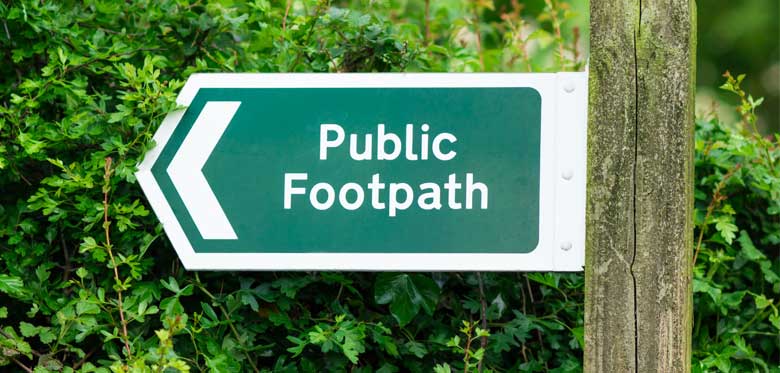
Under English and Welsh law, a public footpath specifically refers to a type of public right of way that allows individuals to pass and repass on foot across private land. Marked clearly with signposts or waymarks, these footpaths give pedestrians access to countryside areas, fields, and occasionally urban localities, providing an important component of Britain's outdoor access network.
Their primary purpose is to allow passage on foot only, explicitly excluding bicycles, motor vehicles, or equestrian use unless expressly permitted by the landowner.
Responsibility for maintaining a public footpath generally rests with local authorities, who ensure footpaths remain accessible, safe, and unobstructed. Landowners whose land includes a public footpath have a legal obligation to keep these paths clear and free of obstruction, and they must permit members of the public to cross their property along the designated route without hindrance.
Understanding rights of way
The broader term 'right of way' covers any legal right to cross land belonging to another individual or organisation. Rights of way can therefore include various forms, such as footpaths (pedestrian rights only), bridleways (accessible to pedestrians, horse riders and cyclists), restricted byways (allowing non-motorised vehicles), and byways open to all traffic (accessible to pedestrians, cyclists, horse riders and motor vehicles).
Thus, a public footpath is merely one classification within the wider group of legal rights of way. Rights of way can also exist as private arrangements, granting permission for specific individuals or groups to cross property, often stipulated through formal agreements or historic arrangements. Unlike public footpaths, private rights of way are not automatically open to the general public, and their usage and maintenance may differ significantly from public footpaths.
Key legal differences and practical implications
To summarise, the primary legal distinction between a public footpath and a right of way lies in their scope and accessibility. A public footpath is a narrow and specific type of public right of way exclusively reserved for pedestrian use, whereas the term 'right of way' encompasses various routes with differing categories of permitted users – including private arrangements tailored to specific individuals or groups.
From a practical perspective, it is crucial that landowners clearly understand their obligations in relation to any public footpaths or other rights of way crossing their property. Equally, anyone exercising access rights should be mindful and respectful of the limitations and usage conditions set out by law and local regulations.
Rights of way and their interpretation under English and Welsh law can be complex and nuanced. Disputes concerning accessibility, maintenance obligations or route diversions may arise. In such cases, it is prudent for individuals and organisations to seek professional legal advice.
A specialist solicitor with expertise in property and land access matters can provide effective guidance, ensuring that all relevant obligations and rights are properly understood and upheld. Contact us today on 0161 696 6178 to speak to our solicitors.
Comments